Thursday, 28 November 2013

Building Materials

As the time line suggests, by now I should have chosen a Dynasty and drawn a few concepts of what my village arrangement could be like as a final set of assets, however due to the amount of feedback I received and work that needed to be done to get up to speed with refining my dissertation, I have pushed the time line back a week to fit in some more posts about textures and materials.

I was advised to look more into texturing as the textures are very important when considering modular components can be tiled and placed along side each other. With this in mind, creating seamless textures is going to be a priority, however before attempting to create some of my own I would like to also research into materials from Chinese architecture as to get some practise for the real thing later on in the project.

 The Chinese used a lot of wood in their structures and also later on some stone, however it was mostly pressed earth and wood. But why did they chose to use wood over the stone? Stone as they would have known was always to last longer. The wood has environmental issues such as weathering  fire hazard and insect damage, however they still chose to build with wood materials, but why?

"Wooden buildings last long enough for more than several generations to live under, but not long enough to become part of archaeological excavations. Buildings were made to be lived under, they weren't made to last thousands of years solely for our benefit. Those that were built to last, such as tombs, did last."

Finding that the structures are made of wood was easy, however all books and websites seem to only suggest wood and not any particular type of wood. However after an hour, I found a website which gave a hint as to what wood was used and why. This wood was White Cedar or also know as Melia azedarach, or even Chinaberry tree. This tree is often found in southeast Asia and produces toxic berries but is mainly used for it's timber, the wood is of medium density and varies colours from light brown to dark red. The seasoning process of the 'Chinaberry' tree is relatively simple as the planks dry without cracking and also have a resistance to fungal infection. This would mean that having huge cracks within the texture isn't required.

Melia Azedarach/White Cedar/ Chinaberry
Small texture file of dark wood


Photograph courtesy of Ronald G. Knapp
1987, Shifuxiang, Zhejiang Province


Tiles are a consistent part of Chinese architecture and keeps the insides of the construction dry, the materials used is clay from the earth, however they use a special construction method to make these which I found that will also help me with my model tile construction.

To the right you can see a woman rolling clay out to the dimensions of the block on the floor, this gives the tile a relatively manageable shape with the tile creation.


Photograph courtesy of Ronald G. Knapp
1987, Li village, Jiande xian, Zhejiang Province


The clay is then rolled over a 'pot' like shape with the makers markings on them, after it has dried it is removed and separated into quarters, which must mean the angle that a tile must be is 45 degrees. It is the fired and painted if necessary.


The walls of the buildings are not load bearing walls and so are made with compacted earth which is then painted white to protect the earth from insects and also weather. I also found that the flooring is made of large slabs of stone from the mountains, From this research I can then find materials that will be needed and create some tileable textures for practise.

Links:


Describes the wood used as White Cedar:
http://www.designboom.com/architecture/the-art-of-timber-construction-chinese-architectural-models/

Chinaberry pictures:
http://www.delange.org/ChinaBerry/ChinaBerry.htm

Clay tile creation:
http://depts.washington.edu/chinaciv/3artile.htm#tile3

Darkwood creation:
http://www.tutorialchip.com/freebies/showcase-of-high-resolution-dark-wood-texture-designs/

Monday, 18 November 2013

Increasing my markable limitations (Polycount and textures)


As feedback I have received a suggestion to research into polygon total and give myself a budget to work with throughout the modelling process. This would have to consider the game engine I will work within (UDK) and also it's limitations in terms of exporting and also texture creation restrictions.

To begin I will by talking about texture limits, from past experience I have found that UDK will only accept textures that are created in 8 bit mode on Adobe Photoshop, this however is not a problem and but a small tweak on the texture creation process. Without doing this, the program appears to crash and close as the texture import process begins, I must avoid this to not waste time. Also upon researching game design forums I have found that UDK will only accept textures in powers of 2, this is also a good habit to get into as other game engines will have the same principle. So 256 x 256, 512 x 512, 1024 x 1024, 2048 x 2048 and 4096 x 4096 are acceptable, however I don't plan to be using the last suggestion as these are considered texture sizes for 'hero' models or player model textures..

"General textures for Static Meshes and CSG Surfaces should still be only 512x512 or 1024x1024 in most cases, with only high detailed textures being at 2048x2048, and that is it."

With this information I have decided that the maximum texture size I will use for my individual modular pieces will be 1024 x 1024 pixels, the models I'm making are not 'hero' pieces and wont need incredible texture quality, also the texture will need to be tile able as the models I'm producing will need to be seamless in texture when positioned next to each other, because of this I cant have a piece of detail that stands out on the textures or the player will see that it is easily tile able.

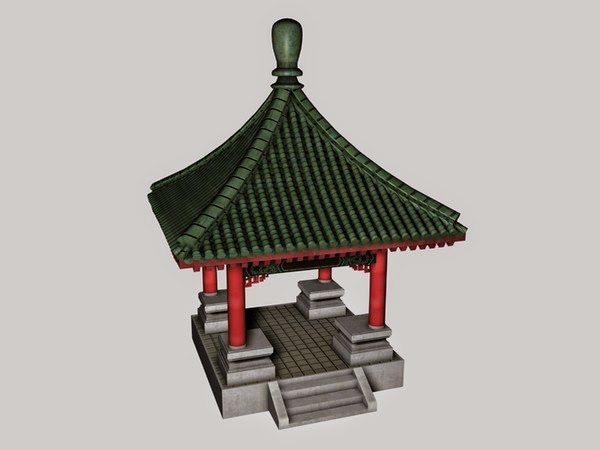
From a mock up model I created a few weeks ago (see previous posts) I constructed a small section of a Chinese building to get used to the Dougong building method. From this I found that the building was 10k polygons, however there are methods that I could of used to reduce the total poly count size. I was also given advice by my lecturer of how I could split up my model to reduce the poly count in terms of each model, doing this would help dramatically to individual pieces, but not the overall kit that I will be creating. This poly count is very high for what I want to create, however I am aiming to build a model that is architecturally as accurate as possible without loss of detail due to poly count size. From researching into poly count and experimenting in 3dsmax, I hope to build my whole kit to be under 45k polygons, although I would prefer to work at a higher polygon limit, this is for a game engine so it will need to be optimised as such and thus a limitation is needed to be put in place.

A small Pagoda I found online

Links

http://www.polycount.com/forum/showthread.php?t=99738

http://www.turbosquid.com/3d-models/pagoda-chinese-3d-model/392786


Sunday, 17 November 2013

Job hunting, yet again...

From my feedback i've been told to look at 3D Environmant Artist jobs. This criteria on these vary somewhat as they aren't always necessarily for game studios, but for graphic design studios.

Position 1 Unknown company (through Blue Skies Marketing recruitment)

Position: 3D Environment Artist
Career level: Executive
Education level: N/A

The company is a leading provider of state of the art software and services to major global retailers and manufacturers. They also specialise in Macro and Micro space solutions, Category Management, Virtual Consumer research and Internal Communications. They are on the lookout for an enthusiastic individual to join the company as a 3D Environment Artist who will be responsible for visualising a variety of retail environments.

As 3D Environment Artist you will have the following skills and experience:
  • Experience in an equivalent multi-media based business preferably dealing with FMCG.
  • Technically minded, a quick learner, and great attention to detail.
  • Excellent problem solving and technical skills.
  • Medium/low polygon modelling and Texture creation.
  • Experience in 3D Studio Max and Adobe Photoshop is essential.
  • Experience in V-Ray and Texture baking would be beneficial.
Link:
http://www.onlymarketingjobs.com/job/1142733/3d-environment-artist/?utm_source=Indeed&utm_medium=cpc&utm_campaign=Indeed

Position 2 Bioware Studios EA

Position: Environment Artist
Career level: Varies upon applicant
Education level: BA or above

BioWare Austin is seeking an Environment Artist candidate with meticulous modeling and texturing abilities to do level/environmental art.

  • Bachelor’s (BA) degree from an accredited 4-year college or university or equivalent industry experience preferred
  • Up to three years in game development, with an understanding of Real time Graphics issues, shipping one or more titles
  • Proficient knowledge of MAX and/or other 3D software package, Photoshop, Z-Brush
  • Ability to work within a style, including a style set by another artist
  • Solid understanding of color theory, and be able to create balanced & appealing color palettes
  • Experience using proprietary editors, software and tools
  • Skilled at modeling supporting assets with or without concepts and designs
  • The ability to create custom materials and all associated maps (bump, normal, parallax, spec, etc.) for new or existing assets
  • Understanding of material shaders and proprietary tools
  • Thorough understanding of architecture and nature
  • Solid understand the aesthetics of environment, function vs. form relationships, as well as what makes a game level fun and intriguing
Link:https://career4.successfactors.com/career?company=EA&career_job_req_id=27449&career_ns=job_listing&navBarLevel=JOB_SEARCH&jobPipeline=Indeed

Friday, 15 November 2013

Dissertation proposal feedback and changes

I recently received my dissertation proposal feedback, and although it wasn't fantastic, I still have to act upon the feedback to create the best journey of learning possible. So below is feedback from both my markers and which I will be acting on as soon as possible. I've outlined in orange what I will need to do to overcome the issue with the proposal or the dissertation overall.

FIRST MARKER COMMENTS:-

Your learning outcomes are reasonably concise. However, you propose to gain a better understanding of texture creation and UV unwrapping, and neglect to include a single entry in your bibliography which addresses these outcomes. This is very concerning. Similarly, you propose to improve your modelling skills ‘overall’. This is an incredibly vague proposition, and impossible to mark. You must be more specific. What are your poly and texture budgets, and why? What textures will your materials comprise of, and how will you be creating your normal maps? Are you intending to create a realistic environment?

I understand how this is important to the dissertation as an assessable piece. Here i will need to look at current examples and my own mock model example and produce a total polycount I can work with. I will also have to research into how large size textures are used in current games. I will although be creating my normal maps using Nvidia's Photoshop normal maps plug-in. I will also be doing a research task where I find and research materials found in an ancient Chinese village and then attempt to produce a tileable texture for that material.

 Your analysis of job adverts is perfunctory. I do not understand, however, why you are referring to a ‘3D Game Artist’ when, presumably, you are tailoring your dissertation to the position of 3D Environment Artist?
 
Although my job searching was slightly off with 3D Game Artist instead of 3D Environment Artist, I didn't think it was "Perfunctory" effort on my part, however. As they are different job positions I will plan to research a few 3D Environment Artist positions and see how they differentiate in terms of skill requirements. to a 3D Game Artist. This will also aid me in choosing whether to focus on improving my 3D modelling efficiency(Polycount) or improve my texturing skills.

 I can see what you are intending to create Tom; however, before you progress, you must provide a more thorough framework for your assessable criteria, and this should be used to better inform your time line.
 
Hopefully, researching deeper into the areas named above, this will eliminate such confusion and produce a markable dissertation.

 SECOND MARKER COMMENTS:-

 Overall I thought this was a solid research proposal. You have undertaken appropriate research into the style of the buildings that you are proposing and this is guiding the research. In regards to the bibliography I wonder if there are more texts dealing with the issue of modularity in the construction of assets and their utility for game production. You have been blogging regularly and this has allowed us to see how the project is progressing so that is very good. Looking forward to seeing how this develops.

Since this has been marked I have created another blog entry on modularity, however I will research further into modularity in the coming weeks.

Tuesday, 5 November 2013

The theory behind Modularity

I was asking some of my readers about my blog and queried them if there was anything missing that they would liked to of seen on here and two of them suggested more information or an explanation about modular assets and what their specific purpose is in a game and the theory behind them. From I've been looking online at articles and found a post by a Bethesda studio employee named Joel Burgess and he explains the theory of modularity and the benefits it gives to his game studio.

Joel explains that modular assets are an import factor within their games due to the fact that the majority of the games he's been involved with are hugely scoped. Fallout 3 (2008) and Elder Scrolls: Skyrim (2011) are games which consist of vastly open worlds which all need filling with content, filling this world with unique designs and models would just be inefficient for the development team as well as the game engine running the games.

Joel mentions that to construct their levels the team construct systems known as 'kits' In this instance he explains how a pipe kit can be used over many different areas within fallout 3 and it's levels. A kits purpose is to be a set of models or items that can be positioned together or uniquely to create something that is often larger as a whole. This pipe kit below from fallout 3 is made up of only four pieces but have a variety of combinations when used together.

Modular assets are fundamental when it comes to Bethesdas techniques in making their games. Although Skyrim was made by a team of only 90 people they were able to make one of the largest open world games on a console to date. Apparently the content in game spans over 16sq miles, this is a big space to fill, and with a small team this would of been impossible without modular assets. Well not impossible, but extremely inefficient and time consuming nonetheless.

Bethesda use the principle that the main character, if humanoid should be exactly 6ft tall or 128 and about 32 Unreal Units wide. As I'm also making a first person game with doorways I will have to also take this into account. Joel suggests that all of their doors within their games are wide enough so that two characters can pass through the doors at the same time, so at least two characters wide. And so maybe I should also take this into account.

I have also noticed over the articles I've seen about modular assets is that they all use a type of grid or scale. Joels calls it a 'footprint' in this article and he stresses how important it is to keep to the grid laid out initially at the start of development. Kit pieces that a level designer finds that don't fit with the grid quite right should be noted and given back to the artist to create a solution for. Luckily the way in which the Chinese build their houses is relatively symmetrical, so constructing houses on a scaled grid would hopefully be pretty straight forward.

Carcassonne, a well loved board game of mine was also mentioned to contain modular art assets within it's creation, however I attempted to think of  my own board game which consisted of different modular assets within it. Settlers of Catan I also consists of modular assets also I believe, with the same principle as Joel explains that is used in Carcassonne, Catan creates a different game board everytime you play a new game, if you don't use the regular set up for beginners.

Links
http://www.gamasutra.com/blogs/JoelBurgess/20130501/191514/

https://starfosterblog.files.wordpress.com/2013/08/settlers-of-catan.jpg

Saturday, 2 November 2013

To village or not to village


Elevated view of a courtyard house in Beijing
After having a discussion with my dissertation adviser about my proposal it was suggested to me to maybe change the overall outcome of what I was producing. He explained to me that the main point of modular assets is that they can be relatively small but create something with great complexity. Although I was proposing to make an ancient Chinese temple with courtyard, this would not require that many modular assets to complete. Furthermore once I had completed the models, they wouldn't have much reusable value, which completely goes against the whole point of creating modular assets for level design. This then made me rethink about my total outcome and bring me back to an idea that was mentioned within a previous meeting, and this was to create a small Chinese village from modular assets.

From images and diagrams from 'The World Atlas of Architecture', houses and temples are made using the same techniques architecturally. Although they are not so flamboyant, they use a lot more enclosure space and white walls. Red timber skeletons are still a huge feature, although they are not so obvious as the temple. Clay tiles are also a common feature as are the way the buildings are organised, through my  research I have found that symmetry is used throughout the whole of Chinese architecture through the construction as well as the orientation and positioning of each building. This is because the Chinese believe in 'balance' within their daily lives.

Also with the creation of a Chinese village I also have the opportunity to make my own smaller temple for the village. As the Chinese are highly religious in their culture, most or all villages have their own temple, be it large or small. If I have time I could also create a small Buddhist temple from the modular assets also. A house in China are simple forms, the majority of houses have courtyards joined onto their houses or even the house surrounds the courtyard. There are no windows on the outside walls, but only on the inside facing the courtyard, this also ties in with the south facing gate, this technique stops cold prevailing wind from the north. The only entrance to the house is often a small gate or fence facing south.

The size of a house is often dependant on wealth, size and the taste of the family, but generally a House compound will have an inner courtyard. Below is a few diagrams showing the basic layouts of many house designs throughout China, this is also similar to how I would hope to design my own assets.


Three-sided courtyard house
Four-sided courtyard house


Double courtyard house

Links

Blog/website that explains the different types of houses, also good variety of diagrams:
http://depts.washington.edu/chinaciv/3intrhme.htm


Sunday, 27 October 2013

Draft dissertation proposal

So this week i've been working on my dissertation proposal. Here is my draft and after i've been advised for changes i'll upload a more accurate one, Enjoy.

Dissertation proposal

After researching into the Culture of China by using videos, articles, blogs and a variety of books; for my dissertation I wish to design and create a small ancient Chinese temple with courtyard using 3ds Max which will be imported into UDK. This temple will be constructed out of modular pieces that a level designer could then create their own temple layout from. The layout of size and scale will be that of a first person game and so the assets will need to be scaled as such. I will be trying to keep as much ancient Chinese architectural accuracy through this dissertation with the structure of these modular pieces which means the models will be relatively high poly.

 Rationale:

The skills I wish to develop over the following year and of the completion of this project are as follows

·         To research and gain more knowledge as well as an understanding of the importance in modularity within games, especially within level creation.

·         From that I also want to be able to learn about a complex system of architecture (Dougong) and replicate that into a 3d model. Building from my knowledge of modularity, to then design these models into modular pieces.

·         Gain a better understanding of texturing and unwrapping models to improve my modelling skills overall to help me obtain a career in the games industry.

 After university, I want to become a 3D Game Artist. Although having a portfolio of work to show will help me acquire a job such as this, I need to work on the skills that are required of me to be employed in that job role in the industry.

 After looking through many 3D Game Artist applications there were many requirements that were relatively common upon the applications. A proficiency in 3DS Max was a requirement on many of these and as I plan to construct my models using 3ds Max, I hope to become more competent using that software package. Great knowledge of Adobe Photoshop was also popular, although I already have a good knowledge of this; I also hope to create a better understanding through the project as I am working alone. High quality texture creature as well as unwrapping skills is one of the skill sets that cropped a lot that I don’t feel very comfortable with so I plan on improving a great deal over this dissertation.  Knowledge of using Normal mapping with the textures was also common; this ties in with the previous requirement also. I have got experience with creating Normal maps for textures but I hope to demonstrate my ability to develop and learn this skill over the next year. I also took the chance to look at a senior position in the 3D Artist job field. It mentions that a “strong knowledge of architecture” is a requirement. This criteria sits perfectly on what I want to achieve over my dissertation; to prove that I can research a highly unknown system of architecture and then to design and create reusable game models from my knowledge and understanding.

 I have a desire to complete this project in particular as I admire the master craftsmanship that can be seen in Chinese architecture over many centuries. I also found that “Chinese architecture has been studied less than the architecture of almost any other great civilization on the globe.” Steinhardt, Nancy 2002 P1. From this fact I also found that they are also missing from our computer games, let alone our western libraries. This is an academic reason why I want to take this challenge on, to construct a scene that is not necessarily fully understood in our culture.


Annotated bibliography:

Below are the books and material I have used for research to support me during my proposal defining process. Here I will name the item and also how it helped me and why.


House Architecture [Chinese Architecture]: University of Washington [viewed 2013]. Available from: http://depts.washington.edu/chinaciv/3intrhme.htm.

 This online blog was hugely resourceful in the information about Chinese house architecture. Especially informative of old Chinese construction traditions such as Chinese orientate their houses South to stop the cold wind from the North. It also gives extensive information about the layout of the houses with sources. The author of this blog however is unknown.

Chen, F. (2009) "how all the Components of a Small [Old East Asian] Building Fit Together". [Dougong Chinese Building]. F. Chen ed., Youtube, 17th January 2009.

This was the video that I used to help construct my mock Chinese building on. It proved very useful in understanding a complex system of ‘Dougong.’ I found no other resource online as clear as this to show how to construct Dougong correctly. From this research I feel that I could construct my own building without guidance.

Chen, F. (2009) Anshina's Architecture (Episode 1): Dougong (斗拱). [Dougong].Youtube/Blogspot: , 31 January 2009,.

Dougong is a complex system of wooden blocks which interlock to create a series of building that can be coloured and very decorative. It also demonstrated to me the difference between each block and why they are called what they are. It had an interesting section explaining that the more layers of Dougong in a buildings construction, the more important the person who owns, works or lives in that building is in society.

Lin, Lentz, Sturgill and Reed 'Using Workflow Techniques and Modularity' DOI http://udn.epicgames.com/Two/WorkflowAndModularity.html.

Modularity I found is an important design choice when it comes to level design and creating game assets. This article teaches you the small things that a 3D modeler can do to help improve the workflow of a development team and the game through subtle change in habits to construct modular game assets. This in turn helps the efficiency and can create a greater game overall. This article I will be using to help me guide myself through the modularity section to my dissertation. This also had a detailed section about using the Grid on 3DS Max and I will hopefully be using this advice in the construction of my models.

Mlicka, A. (2006) The Psychology of the Interior. [PDF Online].BFA ed. Personal Website: June 2006.

From research into the construction of homes I found that the Chinese see a wall as a symbolic space maker and not a load bearing object in construction. From that I was advised to look up this article about The Psychology of the Interior. Mlicka goes deep into the meaning of a wall in different cultures which made me think highly of when I construct my own modular assets. The walls will need to be considered an optional asset to tie in with Chinese architectural culture.

Norwich, J., John. (1994) 'China' in Norwich J., John. The World Atlas of Architecture. 1st ed. London: Mitchell Beazley Publishers, Dec 1994 pp. 18-32.

The information and illustrations within this book inspired me to look deeper into the architecture and culture. The attention to detail of the illustrations of houses as well as the layouts of palaces are useful for deciding on my modular cut off points and orientation of objects. It has an interesting section about the architecture of monuments p28-29 which I will find useful for the layout of each asset.

PERRY, L. 2002, November 2002. Modular Level and Component Design. Game Developer Magazine 1(1), 30-35.

This article was written by the lead level design for the video game Gears of war for Epic. In this article Lee Perry explains the importance and advantages of using modular assets for the use of level design.

Rawski, E. and Rawson, J. (2005) 'Imperial Architecture of the Qing: Palaces and Retreats' in Rawski E. and Rawson J. China: The Three Emperors 1662-1795. 1st ed. London: Royal Academy of Arts, pp. 54-62.

The section of the book illustrates the symmetry involved within Chinese construction and helps me emphasis the reason for creating this dissertation out of modular pieces.

Xinian, F. F., Datheng, G., Xujie, L., Guxi, P., Yun, Q. and Dazhang, S. (2003) A History of Chinese Architecture 1st ed. Yale University Press, 4 Feb 2003.

This is quite possibly the most important piece of research to my dissertation, this is one of the first books that take six Chinese architects and get them to talk and explain about the different types and architectural techniques over the history of Chinas existence, even from before China existed. The book explains why and how China made their buildings modular. They have the ability to deconstruct a building and re-erect it perfectly without the need for nails or adhesives. Also explaining about how radical Chinese building techniques were that Korea and Japan took the same principal and used them in the majority of their own architecture. There are also diagrams showing how Dougong is constructed within some of the elaborate structures as well as decorations of the system.

Yu, M., Oda, Y., Fang, D. and Zhao, J. (2008) 'Advances in Structural Mechanics of Chinese Ancient Architectures'. Frontiers of Architecture and Civil Engineering in China, Mar 2008, 2 (1), pp. 1-25.

The structure of the system Dougong and how each piece interacts with each other are shown here, as well as different types of joinery are shown. Helpful for when I come to designing and making my own modular assets.

Zhang, S. and Lu, R. (2012) 'ICA3D – Intelligent Computer-Aided Ancient Chinese Architecture Design'. Advanced Engineering Informatics, 10, 26 (4), pp. 705-715.

Here I found research about a 3D modeling package that has been designed to produce a Chinese architecture instantly, however the parameters you need to put within the program to get what you need, requires a great amount of detail and knowledge of Chinese architecture.

 Project Timeline:

4th November - Finish draft and hand in final dissertation proposal before the 4th of November

 25th November – Have researched into one dynasty of the Chinese culture and choose the style of village I want to create. Also begin to draw top down layout designs on how I would like my temple and courtyard to look.

 9th December – Decide on scale and size of the models as well as to construct an asset list of what will need to be modelled. Complete individual drawings of the general look of each model to aid in the construction of the models.

 20th January – To begin or have modelled each asset without unwrapping UVW’s. Test scale and size in UDK where possible. Assemble a basic model of the modular assets to see them all together.

 17th February – Continue modelling if needed and start UVW unwrapping on each asset ready for texturing. (May take longer as not as experienced in UVW unwrapping)

 10th March – Begin the texturing of each asset

 24th March – Import and construct the temple within UDK with textures and assets.

 7th April – touch up and add more details to models where needed.

 7th April - 15th May – Work on finalising dissertation

 17th May – 16th May to be the absolute deadline of handing in dissertation.

 Word count: 1829